
AI Agent Governance: Why Enterprises Need Runtime Controls Beyond Traditional AI Policies
Content Writer & Research Analyst

AI Agent Governance: Why Enterprises Need Runtime Controls Beyond Traditional AI Policies
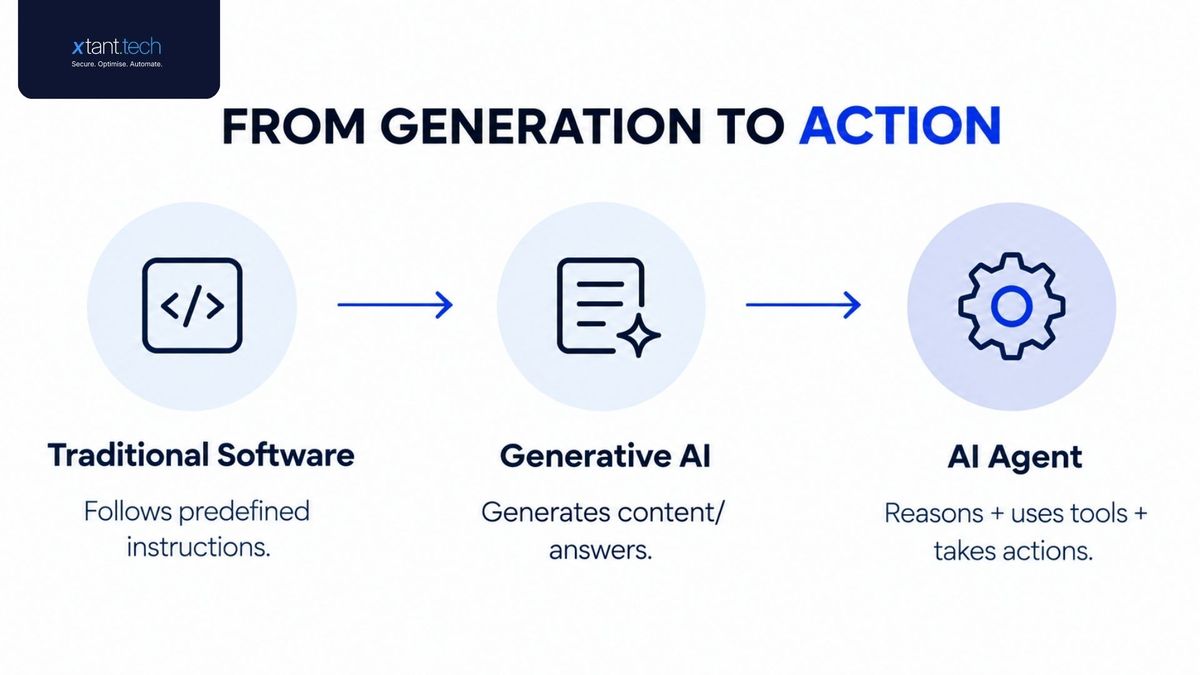
Recent conversations in enterprise AI has been about chatbots and copilots. A company would give employees an AI assistant, connect it to some internal information, and put a few rules around how it should be used. However, that norm is changing.
AI agents are now being designed to do much more than answer questions. They can now process data, use tools, interact with APIs, carry out multi-step tasks and, in some cases, take actions across business systems with limited human involvement.
The National Institute of Standards and Technology (NIST) has even launched an initiative specifically focused on standards for AI agents and is developing security controls for both single-agent and multi-agent systems.
This has led us to a new governance issue. We can no longer worry just about what the AI models can create, but also what they can do.
When AI starts taking action
Agentic AI can not only summarise financial information, but can also retrieve records, work with spreadsheets, call software tools and prepare or trigger certain actions.
While these features has various benefits, it can also create potential risks. If the agent has more access than it actually needs, and then, follows an unintended instruction or interacts with a system in a way its developers did not anticipate, it can be incredibly dangerous.
This is why AI agents need to be treated differently from ordinary software.
For example, Google Cloud has been adding agent identity, access management, guardrails and runtime defence to its cloud security approach because autonomous agents can operate across sensitive data and systems at machine speed.
The basic security principle is pretty straightforward which is to give something only the access it needs. The difference is that an agent may be making decisions and taking actions continuously, which makes the controls around it much more important.
A policy on paper is not enough
Most enterprises have already in place written policies with added rules about data access, acceptable technology use, security and compliance.
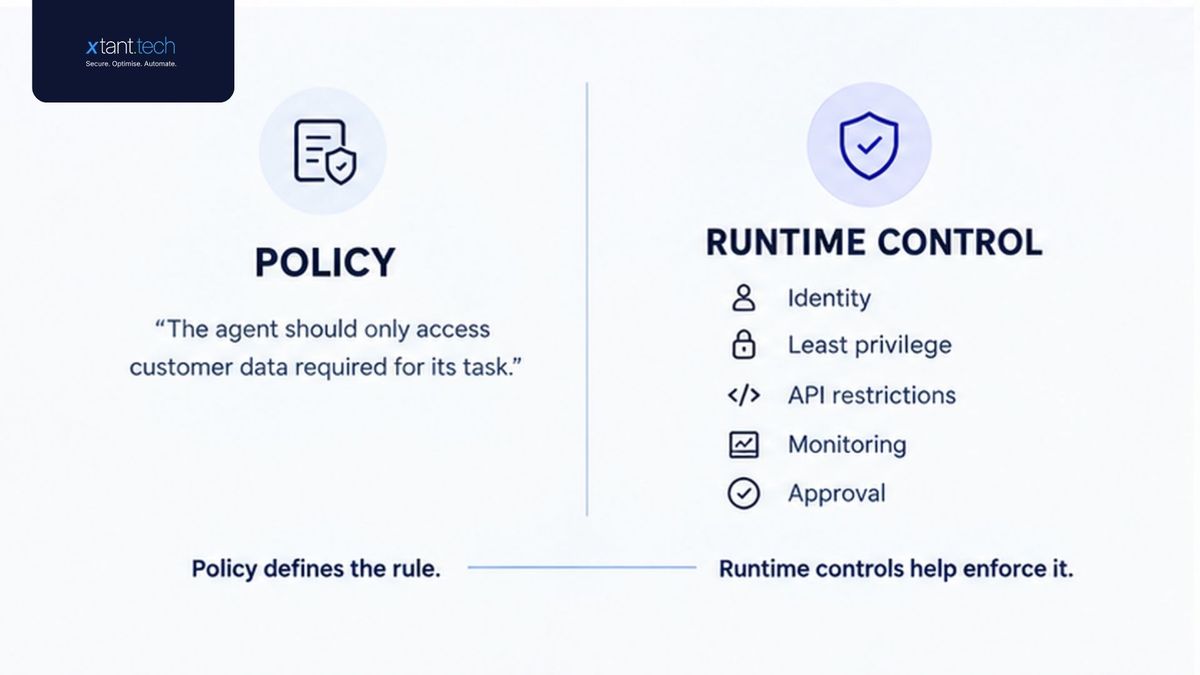
But consider a simple situation. A company's policy says that an AI agent should only access customer information when it is necessary for a specific task. If that same agent has technical access to an entire customer database, the policy alone is not doing much to stop misuse.
This is the governance gap that is being created with the emergence of Agentic AI.
Gartner recently highlighted the difference between written policies and the runtime controls needed to manage autonomous actions.
So, organisations must move from simply prompting AI what it should do to controlling what’s its technical abilities are.
The ideal runtime governance framework
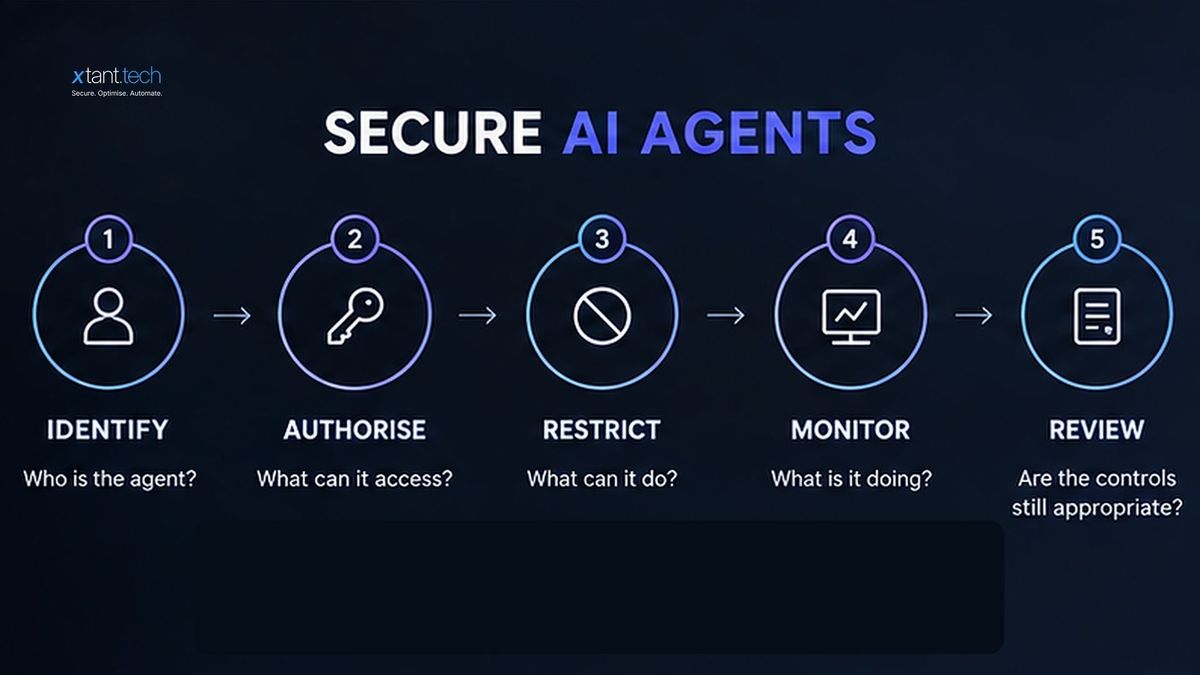
There is no single solution to the problem. The practical approach is multi-layered.
First of all, every agent should have a clear identity and appropriately limited access. Secondly, agents should only be able to use the systems and functions available for designated tasks. Thirdly, human intervention is required for consequential tasks. Also, organisations should know what an agent did, what it accessed and why an action was allowed. Finally, agents should operate within defined boundaries, with mechanisms to stop or isolate them when necessary.
Recent industry developments show just how quickly this sector is moving. On September 28, 2026, NVIDIA introduced its Open Agent Safety Platform, including OpenShell, a secure runtime designed to enforce boundaries around agent activity, and Sentry, a monitoring and enforcement layer.
The important point is not any particular product. It is the direction the industry is taking with security and governance moving closer to the runtime environment where AI agents actually operate.
Where does ISO/IEC 42001 fit in?
ISO/IEC 42001 provides a structured management system for organisations that develop, provide or use AI. It covers areas such as policies, risk management, accountability and continual improvement.
A policy may define the acceptable use, a risk assessment may identify excessive permissions as a concern but runtime controls are what’s needed to enforce that decision when the agent is actually operating.
With the increasing use of agentic AI in enterprises, it’s essential to have a governance framework that’s being put into practice.
The next step for enterprises
Before deploying an AI agent, organisations should be able to answer a few basic questions, such as:
- What can the agent access?
- What actions can it take?
- Which actions require approval?
- How is its activity monitored?
- Can its decisions and actions be audited?
- Who is responsible when something goes wrong?
- And how quickly can the agent be restricted or stopped?
These are not questions about slowing AI adoption, but about making its adoption sustainable. As AI capabilities rapidly develop, its governance can no longer exist just in words. It needs to become part of how AI is designed, deployed, monitored and controlled.
The future of enterprise AI will depend not only on what agents can do, butalso on whether they can be put behind necessary guardrails and if the organisations can abide by it.
Author
Kashif Hussain
Kashif Hussain is an advocate and a Content Writer and Research Analyst at Xtant.tech, with experience in legal research, journalism and content development. He is interested in the evolving relationship between technology, cybersecurity, AI governance and regulatory frameworks. Through his writing, he aims to simplify complex topics and explore how emerging technologies are shaping businesses, industries and society.
Put this into practice
Let's make your AI assured.
Reading about governance is the easy part. In a free 30-minute call, we'll look at your AI systems and tell you what to fix first.